
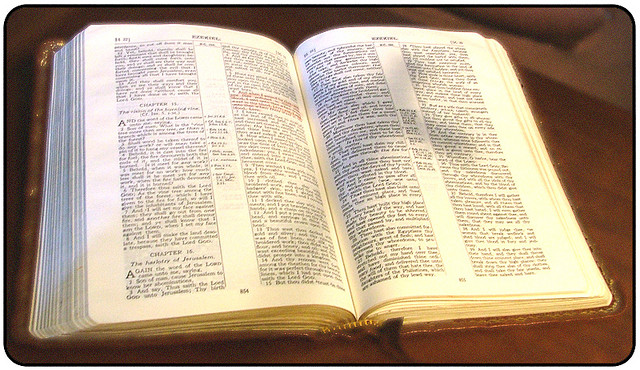
Cards on the table. Growing up as a child, I read The Living Bible, a paraphrase of the Bible that was easy to read and understand. This was my main Bible from the ages of 4 to about 15. I gradually transitioned to the NIV, requesting a hefty leather-bound, commentary-laden edition for my 18th birthday.
19 years and many Bible studies later, slightly the worse for wear, this remains my main (printed) Bible. The advent of the internet and the easy accessibility of multiple versions has somewhat relegated the printed word, but my old Bible still brings with it a sense of comfort, peace and tradition – in a good way.
Of course there now exist many different versions of the Bible, all rendered with different objectives and varied levels of scholarship. If your faith rests on the word of God (faith comes by hearing and hearing by the word of God, says Paul in Romans 10:17) it is important to know where that word may be found.
Many Christians today refer to their Bibles as “the word of God” and here we come to the heart of our discussion: In a recent sermon, I quoted some passages from The Message. My reasoning was that I was reading a familiar passage and it is sometimes helpful to hear that passage in unfamiliar language, to ensure we don’t “switch off”.
I had not anticipated that one of my friends and someone whose spiritual integrity I trust, would question my use of The Message and further, question whether The Message even deserved the right to be called “the Bible”. The fundamental objection is that “The Message is a paraphrase”.
Broadly we divide Bible versions into two categories: translation and paraphrase. Doing so, we may be forgiven for thinking that there is a clear distinction between the two approaches, or that one is “superior” to another. But I do not think that the differences are as black and white as they might appear.
As I understand it, the objective of a translator is to take a text and render it in as nearly accurate a form as possible from the source language to the destination language. With paraphrasing, the author may start with the source language or with a pre-existing translation and then seeks to render it into a modern idiom – that is, using expressions that are particularly meaningful in a certain time and place. (Note, the foreword to The Message states that Peterson wrote “straight from the original text”.)
It is hopefully clear that paraphrasing intrinsically involves interpretation. The author of the paraphrase has to attempt to understand the gist of the source and predict how the source could best be understood in modern (colloquial) language. In this case, if the author’s understanding is faulty, the paraphrase will be equally faulty. The author considers that risk to be worth taking: If the author’s understanding is accurate, the target audience should be able to understand the paraphrase with no further assistance. The weakness of course is that, as language develops, the paraphrase becomes outdated quickly. Furthermore, a paraphrase into American English, say, may not result in a completely intelligible read for an Australian or British English speaker.
What may not be obvious at first glance is that translation also involves an element of interpretation, especially when the source text is an ancient language and no native speakers are alive to verify the accuracy of the translation. In all likelihood, the source text, regardless of its age, will contain idioms and colloquialisms that would be difficult to understand without background knowledge. A literal translation could in fact do damage to the text. For example, a literal translation into other languages of the expression “it’s raining cats and dogs” would be unlikely to leave the reader with the impression that it’s raining heavily. More likely, they would wonder what strange phenomenon has occurred to cause domestic pets to fall from the sky.
One further problem of translation arises: the rendering will typically require interpretation and understanding on the part of the reader. Since the objective has not been to create a colloquial version of the text, the reader is left to apply her own understanding to the work. With translations (as opposed to paraphrases) of ancient texts, the risk of misunderstanding the text must consequently be greater.
Where does this leave us?
Regardless of the method of rendering, it would be a mistake, I think, to describe any English version of the Bible as “God’s word”. At best, it is a translation of God’s word. Fortunately we have the great benefit of the Holy Spirit, who communicates with us through and in addition to our English versions of God’s word, helping us to understand the text rightly. Is it acceptable though to refer to paraphrases such as The Message as “Bibles”? Given the inherent difficulties of translations and paraphrases, I would not personally withhold the title “Bible” from either. By analogy, hammers and spanners are both “tools”. The Message and the KJV are both “Bibles”. Which is better, a hammer or a spanner? Neither: they are different and have different strengths and weaknesses. Which is better, The Message or the KJV? Neither: they are different and have different strengths and weaknesses.
All translations and paraphrases share a common divine heritage blended with a human (therefore flawed) understanding. Let us not elevate any particular version to the state of deification. Rather let us thank God for the gift of His Word and the gifts he has given his servants in translating and paraphrasing for our benefit. And further let us thank him for his Holy Spirit who will guide us into all truth (John 16:13).
Practical note: due to the strengths and weaknesses of each version, when attempting to understand a passage, it is prudent to consult a range of Bible versions and to ask the Holy Spirit to guide us in our understanding. Also, it is helpful to be mindful of the credentials of the authors of the versions. In the case of The Message, as with many other versions, those credentials are impressive (many scholars contributed to the final text). This is also the reason why I would dismiss a translation such as the Jehovah’s Witness’ version of the Bible, the New World Translation – the translators’ credentials are reputedly either poor or hidden.
Bible image copyright © David Campbell, licensed under Creative Commons. Used with permission.

I have to emphatically disagree with your conclusions. The Message waters down and eviscerates so many key points in the Bible. Relying on it or producing something like it is DENYING GOD THE HOLY SPIRIT, Whose job it is to cause a person to understand. God doesn’t need the help of a man who has arrogated to himself the “right” to rewrite what God wrote. The Bible is mathematically precise. When translating it, the actual meaning must be preserved at all costs. Most of the time this means a literal almost word for word translation, and in a few instances, substituting another word where none exists in that language (for example, looking for a word that implies purity like “snow” in a language of a people who have never seen snow.) To be honest, I have to question whether ANYONE who sees value in The Message even HAS the Holy Spirit, and without the indwelling of the Holy Spirit, a person is not saved. And I precisely mean to say that. It is a warning. I urge you to heed it. Do not lead others down the path to destruction. You will be held accountable.
Mm. I wrote that post about fifteen years ago. I can’t remember the last time I picked up or referred to the Message when preparing a sermon (or for personal study). Honestly, I don’t personally find it that helpful, and I now share some of your concerns about the potential editorial bias in the translation/paraphrase process.
That said, I still believe it can be used, with caution. I have twins with significant disabilities (one is now with Jesus). This opened to me the world of learning disability, which raises a very practical issue of which Bible version to use with those who find a “mainstream” translation inaccessible. The Message sits for me in that category of versions that may be helpful to assist in expressing Biblical issues in easier language. I wouldn’t look on it as “the word of God”. For me, it’s more like a commentary.
I don’t think I can get on board with the “mathematically precise” assertion, largely because it’s so difficult to determine which is the correct original version of the manuscript. Many manuscripts exist of the same texts, with sometimes subtle, sometimes significant differences. Many translations include the dubious Mark 16:9-20. And many idioms are in use, which makes linguistic precision (let alone mathematical precision) difficult. I know enough about mathematics to appreciate that if one small part of an equation is different, the answer will be different too.
Maybe the texts were mathematically precise in their original versions. Maybe they weren’t. We don’t possess the originals, so it’s almost impossible to say. I don’t think it’s necessary, personally. If it were, you’d have to think that the chain of provenance would have been guarded with even more care.
I do think though that many of the Biblical authors were extremely precise with their language though. Take Jonah for example. It has incredibly intricate structures and layers within layers. Many of those aren’t apparent in English translations. What then do we say about those translations? They’ve rewritten the original? They defy the Holy Spirit?
Pat, I don’t think we know each other. Perhaps if we did, you’d take a different view of my salvation. Who knows.
What I can say is that I’m a sinner, saved by grace. To the cross I cling, with my flaws and all.
May God bless you,
Rob